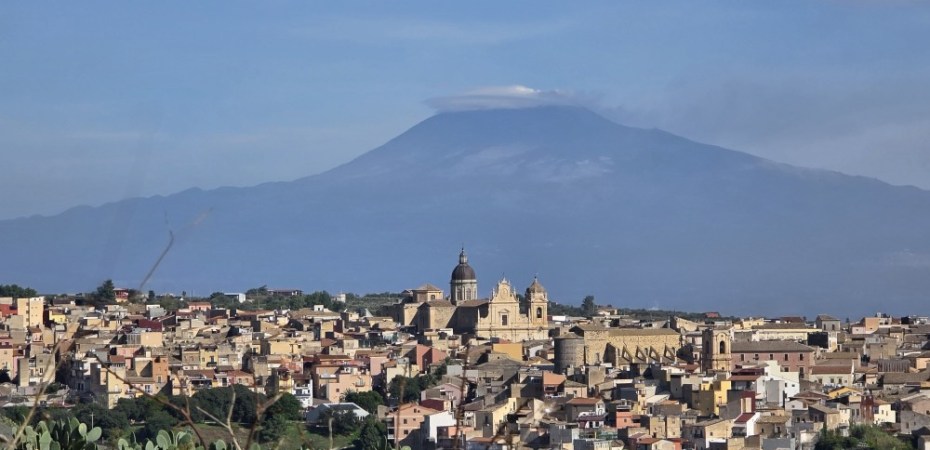
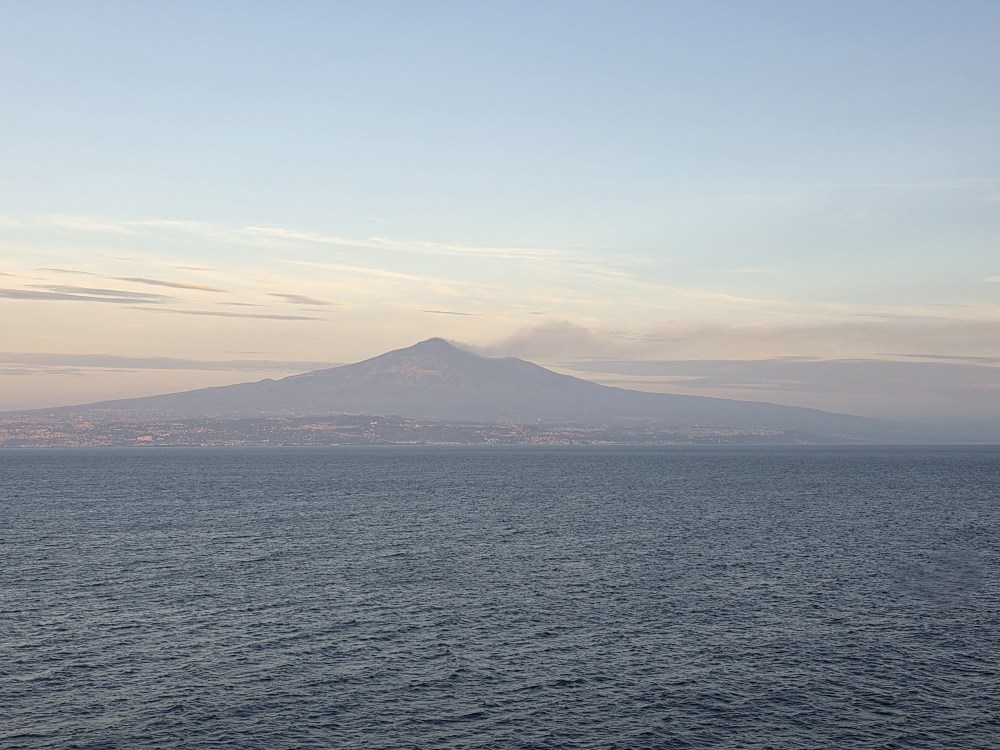
It is another beautiful day with an incredible sunrise and views of Mt. Etna as we sail toward Sicily. We are up really early, too early for the gym, so we walk the empty track on deck 10, stopping here and there for more Mt. Etna pictures.
Once outside, we find our Budget, pick up our car and are on the road a little after 8:30. Perfect for our day of explorations in the hinterlands. Our ultimate objective: An 18th Century tannery hamlet called Cunziria – abandoned in the 1920s and now a tannery ghost town. But in between there are a couple of different abandoned villages and even boarding schools we are interested to explore.
We hit the autostrada, stopping at a rest stop for the facilities right before our turn off the highway, before heading out on our journey, only to have the car start acting funky. There is some sort of auto-regulator that won’t let it go over 35 miles an hour, no matter what we do. Adding frustration and fright, we are on a narrow access ramp (guard rails on both sides of a one lane road) that leads to the more rural roads we need to take to get to the villages. We cannot figure out how to turn the darn thing off or what to do – cars behind us honking and getting totally angry with us because we can’t go any faster and they can’t pass. We finally reach a widening of the road where we can pull over – and fortunately, when we shut the car off, it reverts back to normal. Phew. That was totally frightening and weird – and we are heading into the hinterlands. Um. We’ll see how far we go…..
Managing to keep the stupid car going in the right gear, we eventually make our way out through country farm roads, framed with tall wheat fields on either side, past old empty and abandoned buildings, now used as sheep pastures and out into more open farmland with gorgeous vineyards and orchards stretching out as far as the eye could see.
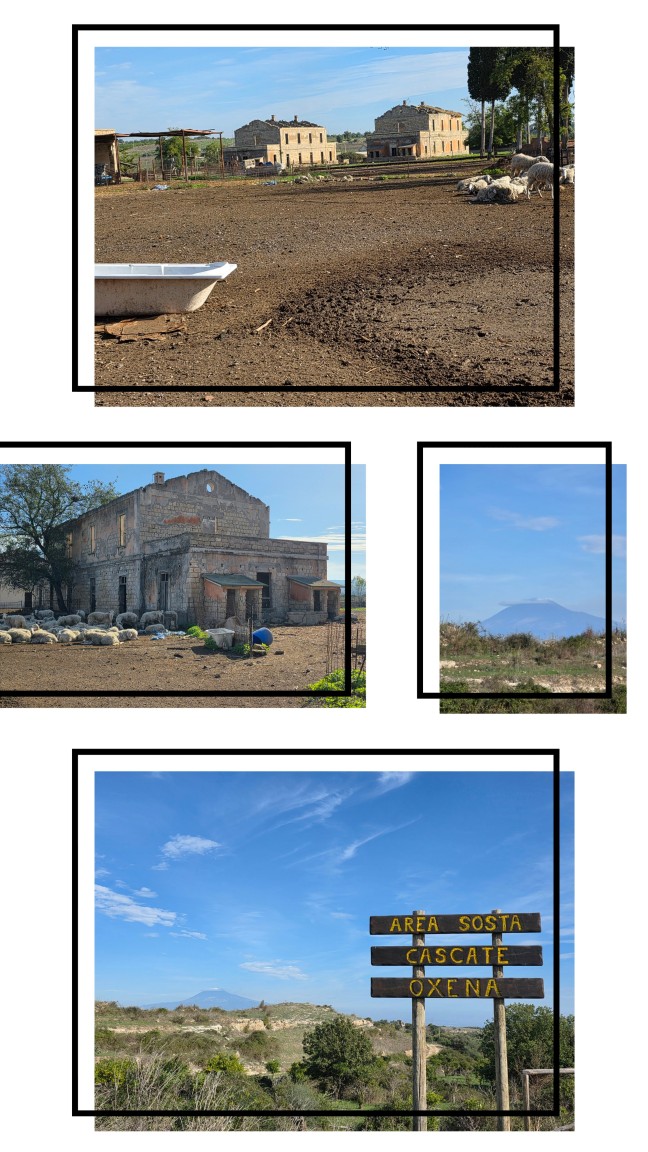
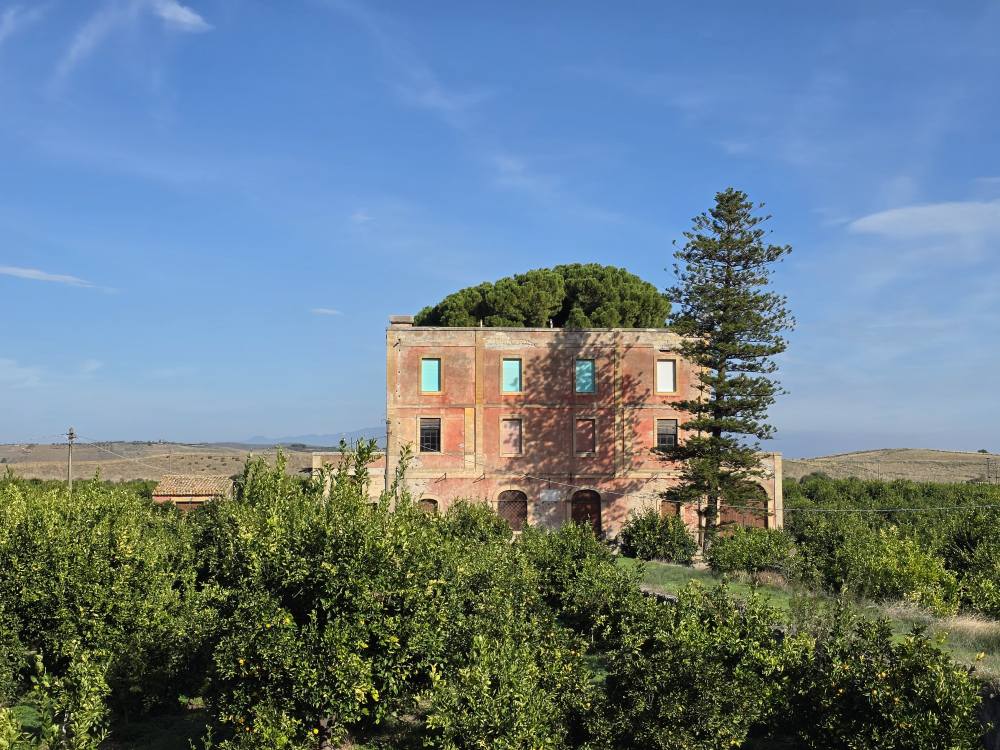
And of course, Mt. Etna always out there in the distance.
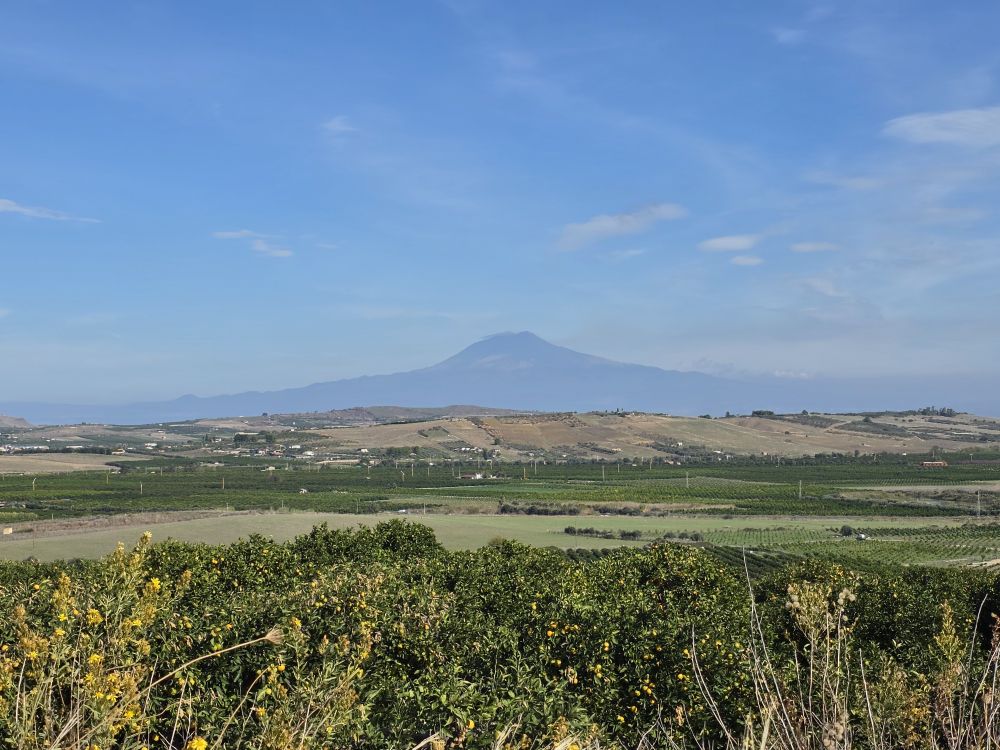
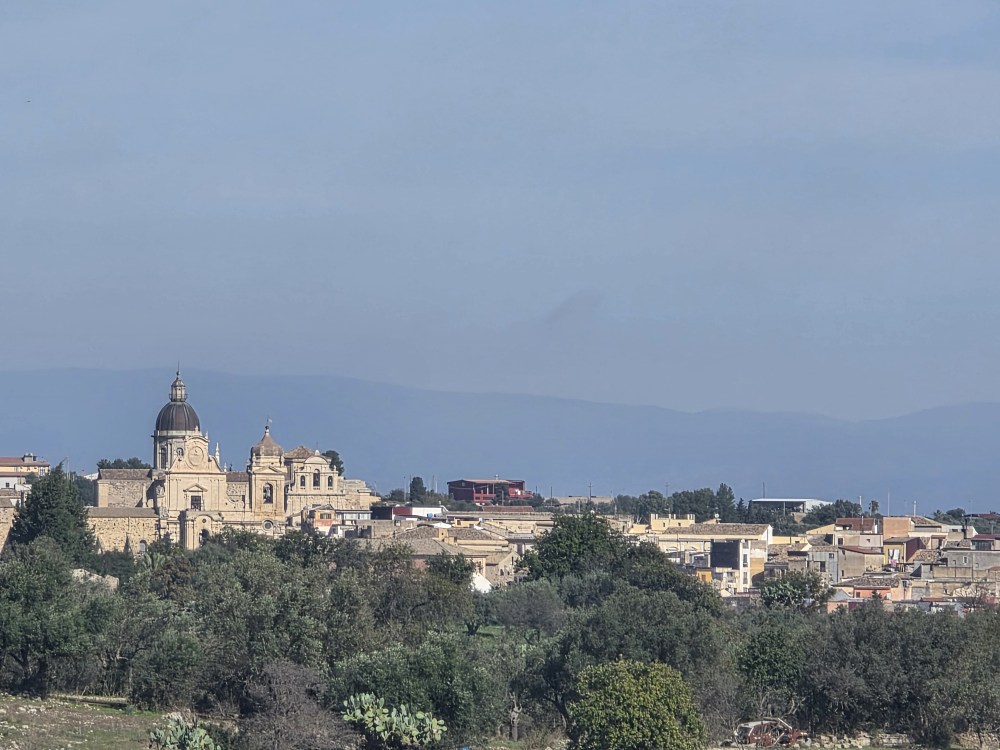
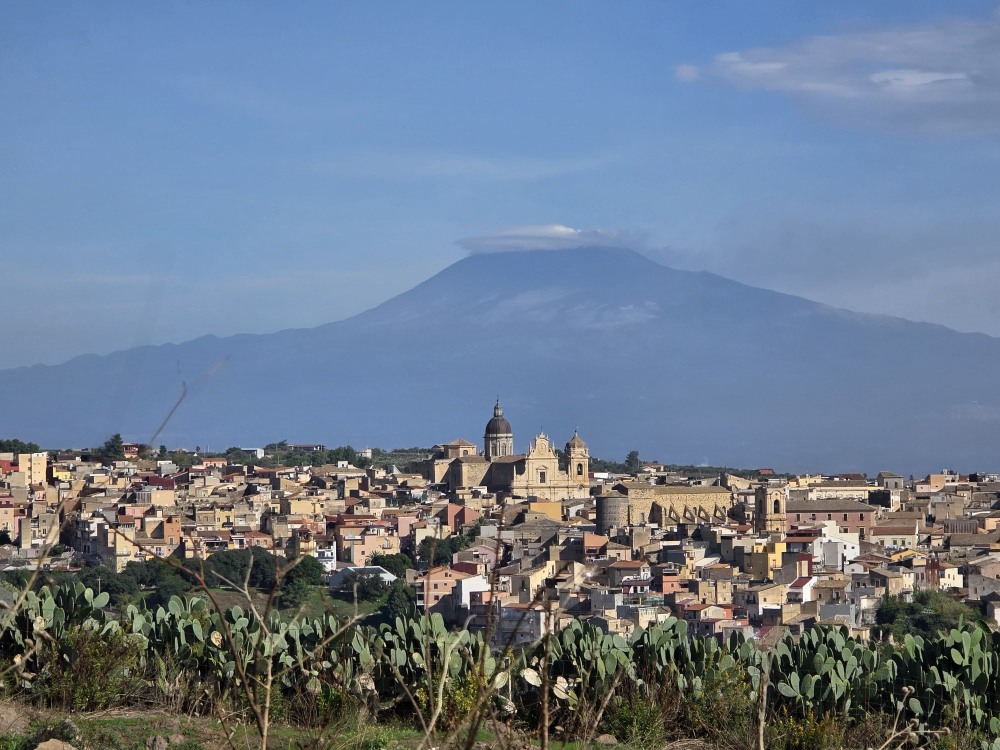
We drive down narrow little roads, passing towns and villages, and tons of abandoned buildings until we reach the road that looks like it goes up to the abandoned boarding school. Um. Nope. We are not chancing that. Wouldn’t actually chance it with a car in good working condition, and we certainly aren’t taking a chance with this finicky weird thing. The upside is that there are fabulous views out across the valley and to the town of Militello in Val di Catania – with its iconic Chiesa San Nicolo towering over the rest of the town. Gorgeous.
One of our stops along the way, Villaggio di Callari – another abandoned ghost town – is just around the corner from here – where we can easily park and explore. A complex of about 20 buildings – including the shell of a really cool looking church – this little village looks like it was set up for agricultural use. We’re not sure, as it was only a blip on our map without much collaborating information. Still it is really wild to walk around and look into all the different falling down buildings and the great carvings etched out of the stone wall beneath the church.
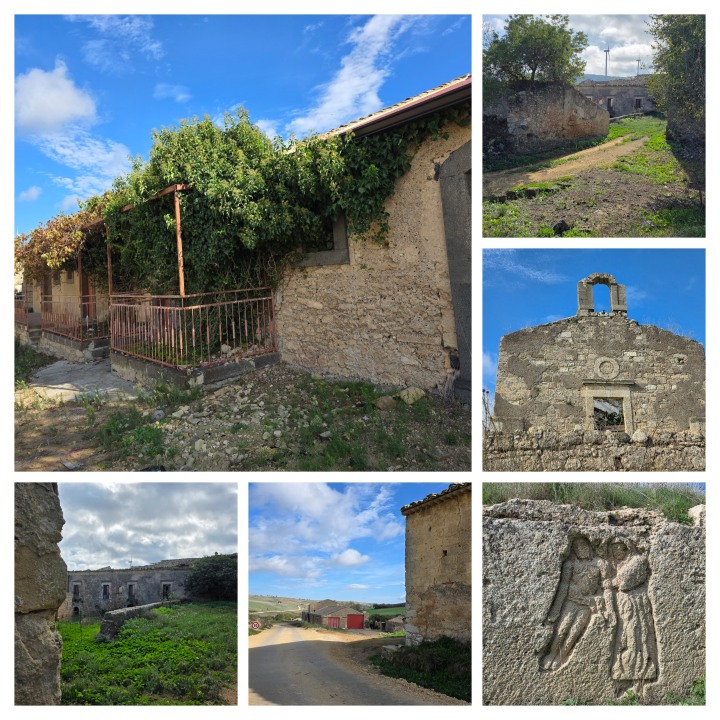
A nice little stop and, after some consideration, our one and only stop on our Sicily Ghost town tour. Because the car is acting so squirrelly, we decide to cut our losses and head back into Catania. It is still an hour’s drive back and we don’t want to take further chances with the car on the little back roads out here in the hinterland. Fortunately, we make it back to Catania safe and sound, with stellar views of Mt. Etna on the way.
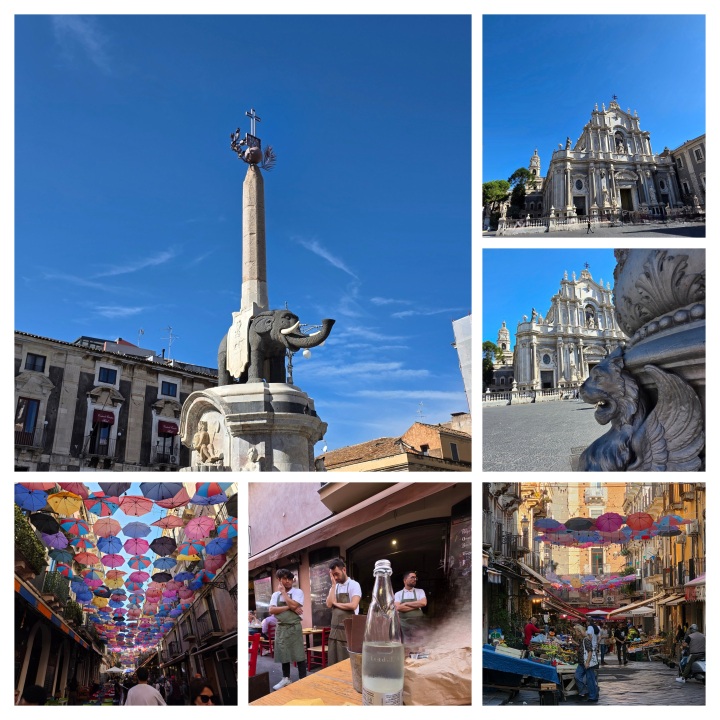
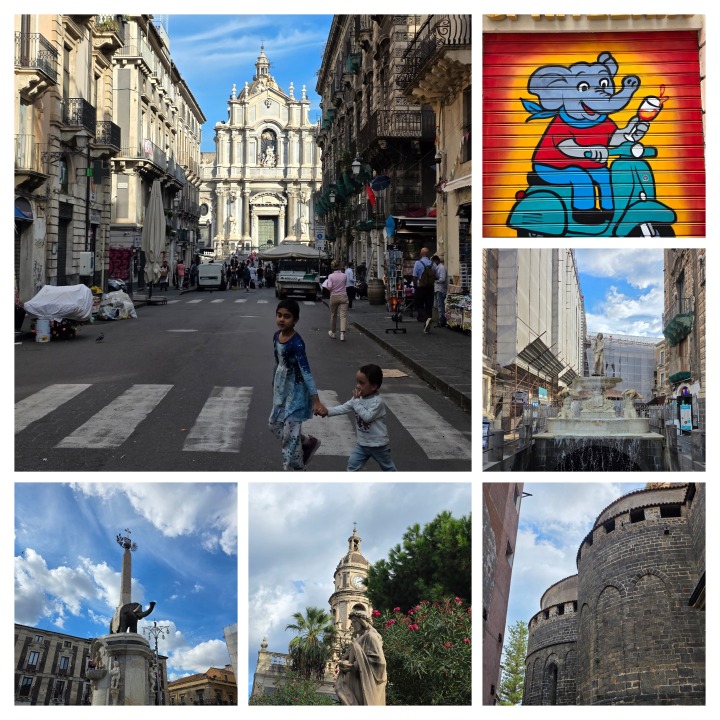
Dropping the car, we then proceed to explore Catania, a city we’ve not visited previously. The old town is awash with fabulous architecture and little snapshots of medieval living. Arriving at the Piazza del Duomo, we wander through the square with the totally cool Fontana dell’Elefante (yes, an elephant fountain – elephants are important in Catania, seen as a legendary protector, a guardian against Mt. Etna, even used on the city’s coat of arms – my kind of place!) at one end and the looming Cattedrale di Sant’Agata on the other. Great place for photos – and people watching, honestly.
Diving into the old town streets, we come upon the “umbrella” lane lined with restaurants on either side. As it is time for lunch, we plop ourselves down at Vuciata, one of the many seafood restaurants here and dig into a fantastic lunch of grilled Octopus (for Ed – of course!) and Paccheri Norma (for me), a traditional Catanian dish of pasta made in large flat tubes topped with tomato sauce, eggplant and fresh ricotta cheese. Perfect Italian lunch for the two of us. (And, no, I couldn’t resist snapping pictures of the waiters in their typical manly Italian poses as they wait – and wait – for more customers! They were priceless in their boredom!)
Back on the streets, we head out to find the Teatro Antico, passing by the monument to Cardinale Dusmet, one of the city’s most revered figures, known for his dedication to the poor and needy, across the square from the beautiful Chiesa di San Francesco d’Assisi. As you can see from our fascination with the church façade and statues, it is quite the picturesque place!
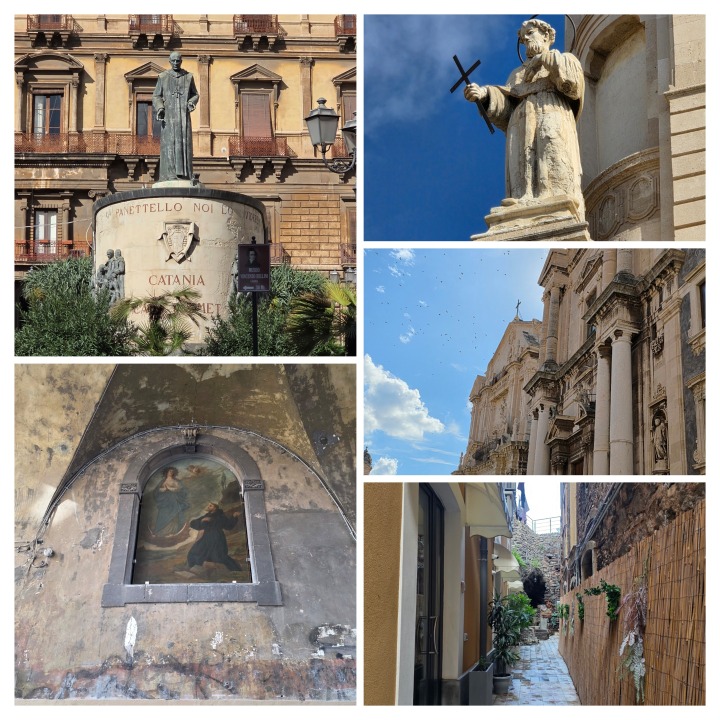
Continuing up the street, under the arched bridge connecting the church to the monastery (reminding us of the Bridge of Sighs in Venice), we find ourselves in front of the Chiesa San Francesco Borgia, and a little bit further up, yet another church, Chiesa di San Benedetto. All on this one street, which we soon discover is the Via dei Crociferi (street of the crosses). Aha! No wonder there are multiple churches here!
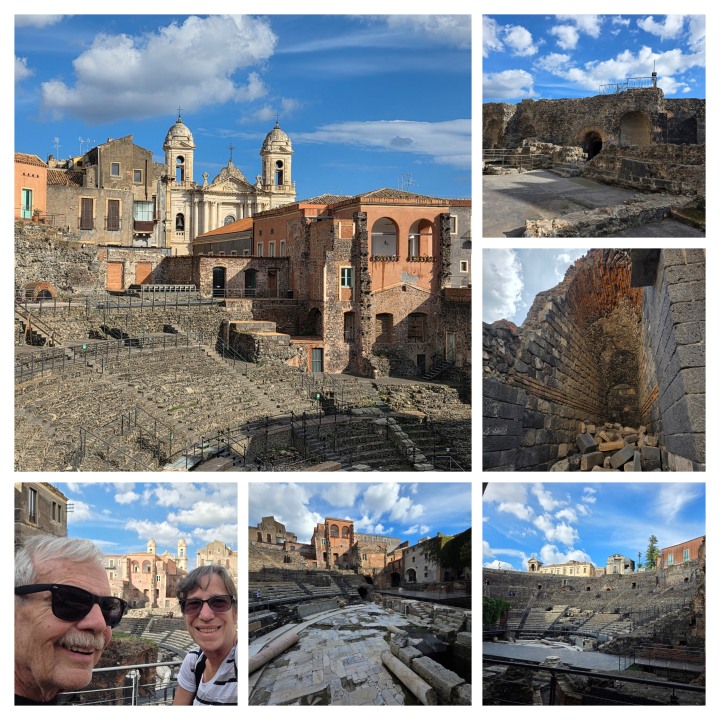
Circling back around church central, we circumnavigate the Teatro Antico, finally finding the entrance on the opposite side of where we’ve been walking. Ah well – exercise – never hurts us. Once inside, we learn all about the theatre that dates back to the 2nd century with additions and renovations made in the 3rd and 4th centuries. In more recent times, the theatre was “covered” by houses – they built houses right on top of the thing! As we move through the different areas of the theatre, we can still see how them today – built right into the walls of the ancient theatre and on top.
Many informational panels explain the excavations – conducted in 2006 and 2007 – with photos of the adjacent residential walls. They even tore down a modern house to get at some of these old, buried chambers and walkways.
Part of the history of the theatre, and subsequent excavations, are due to the latest owners of a small house, casa palazzata, the Liberti family, that was built on top of the theatre. With the help of one of the descendants who donated documents, the foundation was able to reconstruct the family history and a timeline of modifications done to the theatre in the 18th and 19th centuries. Parts of the casa palazzata have been recreated to give a sense of the residential homes that overtook the theatre.
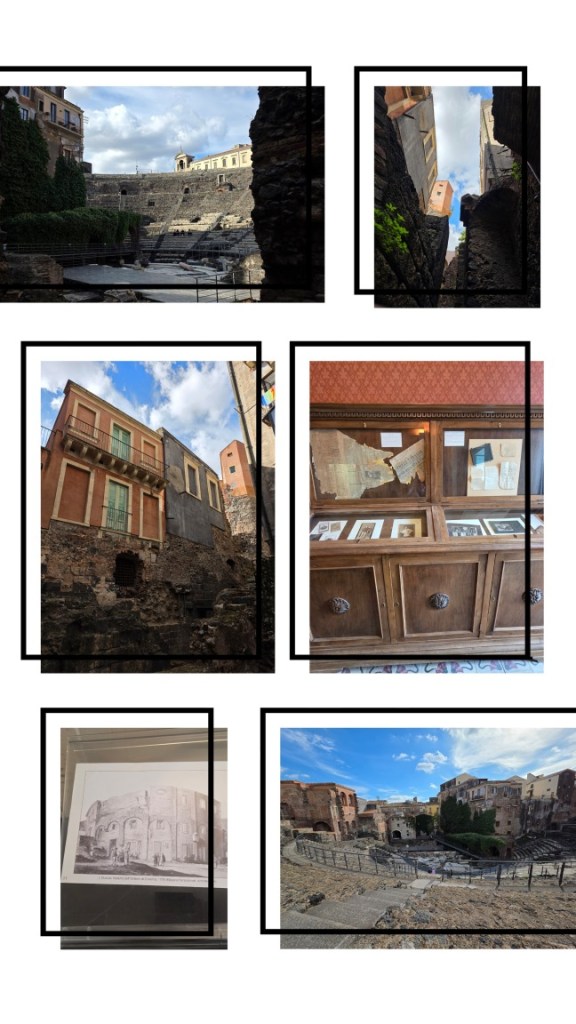
Another section of the theatre holds historical photographs giving a visual perspective on how the theatre would have looked in its day, how it looked with all the homes built on and around it, and then the excavations. Really fascinating – even more so that the city was able to remove all the houses to bring back the historical archeology.
Circling the whole complex, we can walk all through the entry halls and up into the theatre proper – where we sit in the cool shade and just drink in the views – the ancient stone Amphitheatre, the new houses built right up on the walls, the preservation of it all. As Roman-Greek Amphitheatres go, this one if pretty interesting just for the way it was completely built upon and then discovered and excavated.
The final part of the museum holds some of the statue fragments found during the excavation –pieces of the Corinthian capitals, Poseidon’s foot on the prow of a ship (the detail there is amazing), a Grifo running. All found during excavations in the 50’s and 60’s.
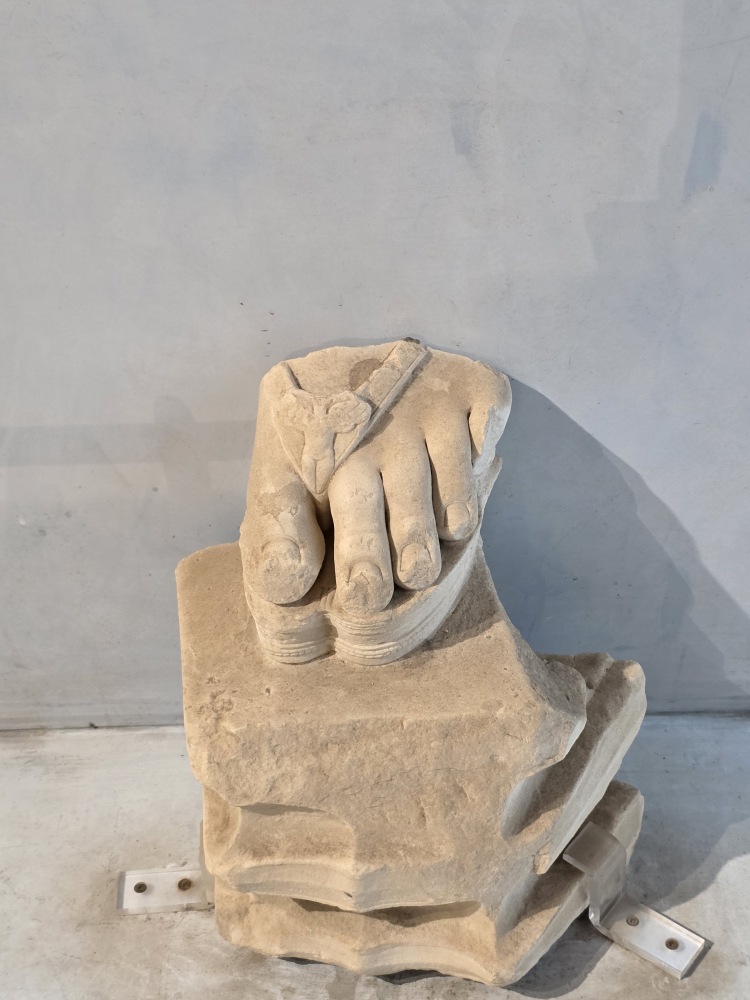
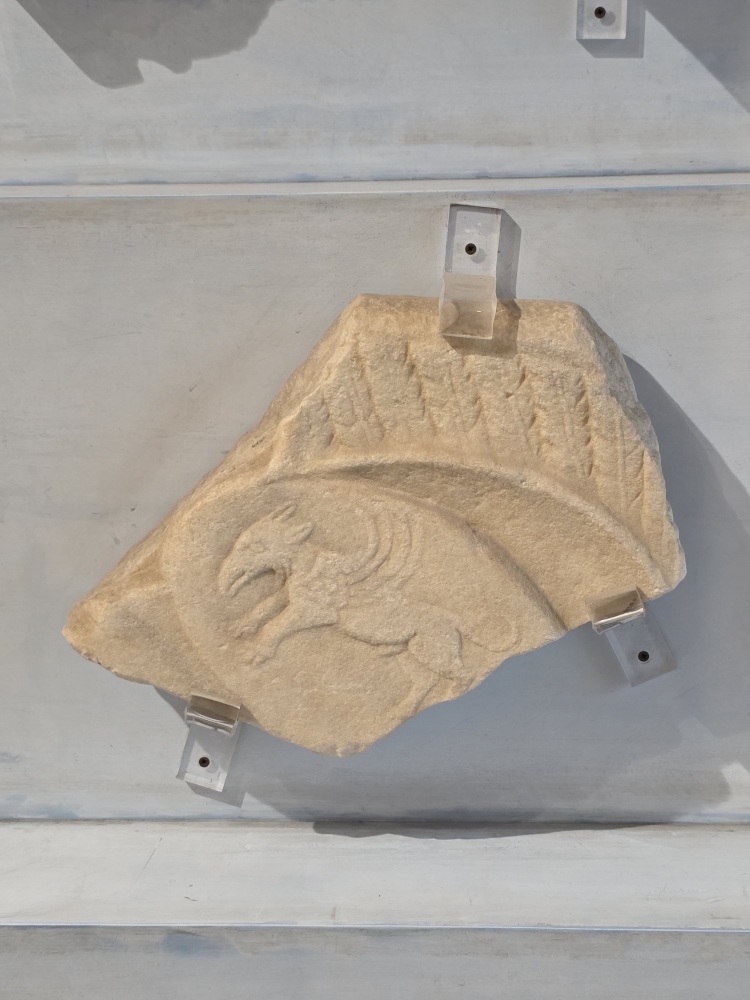
A great unexpected visit, for sure. Back out onto the streets, we still can’t get enough of the architecture – or the elephants, they are so pervasive, and some so cute – as we head back to the ship, once again past the Piazza del Duomo, the Fontana dell’Elefante and the Cattedrale di Sant’Agata with its lovely gardens and towering stone walls along the side of the road.
Back on the ship, we complete our normal afternoon activities, then hang out on the balcony for our sailaway, watching as we glide by the painted grain silos at the end of the dock, then off into the dazzling sunset. Tomorrow, Salerno awaits.

